
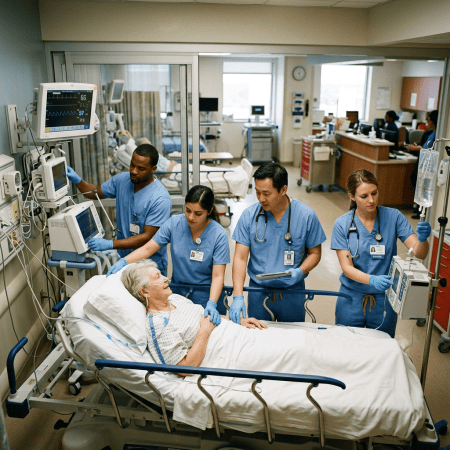
Whenever we approach a patient at the bedside, whether as a healthcare professional, caregiver, family member, or minister, we bring more than our knowledge and skills. We also bring something deeply sacred: the gift of ourselves and our presence, through which God’s compassion and love can be made present to the person before us.
I have come to see the bedside almost like an altar. We approach it with respect because we are entering a sacred space. There we encounter the mystery and vulnerability of human life. Before us is not simply an illness, a medical condition, or a diagnosis, but a human person with dignity, fears, hopes, relationships, and a story.
At the bedside, we may meet someone who is suffering, struggling with illness, afraid of what will happen next, or trying to make sense of what is happening. Sometimes the person is asking difficult questions: “Why is this happening to me?” “Will I get better?” “What will happen to my family?” “Where is God in my situation?”
We may not always have answers. But we can be present.
Where Medicine and Compassion Meet
The bedside is where medicine and human compassion meet. We see the physician trying to understand and treat the illness, the nurse relieving pain and attending to the patient’s needs, the family member holding a hand, and the minister praying and offering words of hope.
The bedside is certainly a place where we witness pain, weakness, uncertainty, and sometimes death. Yet it can also become a place of extraordinary love. It is where concern becomes visible, and compassion becomes tangible.
A gentle touch, a listening ear, a few comforting words, a prayer, or simply sitting quietly beside someone can communicate something powerful: “You are not alone. You matter. I am here with you.”
These actions may appear small, but when someone is sick, frightened, or uncertain about the future, they can take on a much deeper meaning.
Never Forget the Person
Healthcare can be extremely busy. There are medications to administer, charts to complete, patients to see, procedures to perform, test results to review, and emergencies to manage. These responsibilities are necessary. Yet in the midst of them, we must try not to lose sight of the person before us.
A patient is never merely a diagnosis. A patient is someone’s mother, father, brother, sister, spouse, child, or friend. More importantly, from the Christian perspective, every patient is a beloved child of God.
This understanding can change the way we approach the bedside. Listening attentively, making eye contact, calling someone by name, or allowing a frightened patient a little time to speak can communicate respect for the person behind the illness.
Clinical and pastoral knowledge is essential, but so is human presence.
The Power of Our Words
We should never underestimate the power of a few simple words.
“How are you feeling today?”
“What are you most worried about?”
“Is there anything you don’t understand?”
“I am here with you.”
These questions may seem ordinary, but to someone who is frightened, suffering, or alone, they can mean a great deal.
We should also remember that words can affect people deeply. A careless remark may increase fear. A dismissive response may leave someone feeling unheard or invisible. On the other hand, compassionate words can reassure a patient and communicate dignity, concern, and hope.
Sometimes communication does not require many words at all. Sitting quietly beside a seriously ill or dying person can communicate more than a long conversation. Holding someone’s hand, when appropriate, can quietly say, “You are not alone.”
Even silence can become a form of presence.
And sometimes silence can become a prayer.
Jesus and the Ministry of Presence
Jesus gives our care for the sick an even deeper meaning when He says, “I was ill, and you cared for me” (Matthew 25:36).
For the Christian, these words invite us to recognize something sacred in caring for another human being. In serving the person who is sick, we may also encounter Christ.For Christians, Jesus offers a beautiful model for how to encounter suffering people. Throughout the Gospels, Jesus does not simply pass by those who need Him. He stops. He listens. He asks questions. He touches the sick. He notices people others overlook, and He lets suffering people come close to Him.
Jesus gives people His presence.
This matters because when someone is suffering, we may feel we must always say or do something. Yet sometimes the greatest gift we can offer is simply to remain with the person.
When we enter the sacred space of the bedside, we can call upon Jesus, the Divine Healer and Divine Physician, to accompany us. We ask Him to be close to the person who is suffering, but we can also ask Him to guide us: Teach us how to care. Teach us how to listen. Give us the right words when words are needed and teach us to remain silent when silence is more compassionate.
At the bedside, our hands can become instruments of care, our ears instruments of compassion, and our words instruments of hope.
When Presence Becomes Ministry
We may not be able to remove every suffering. We may not be able to answer every question. We may not be able to cure the illness or change the prognosis.
But we can offer our presence.
And sometimes presence itself becomes ministry.
The ministry of healing is not always about restoring someone to physical health. Sometimes it means accompanying a person through illness with courage, dignity, peace, and hope. Sometimes it means listening to fears that cannot easily be resolved. Sometimes it means praying with someone. And sometimes it means simply assuring another human being that he or she does not have to face suffering alone.
This ministry does not belong only to priests and chaplains. Doctors, nurses, caregivers, family members, and friends can all become instruments of compassion through the way they accompany someone who is suffering.
We do not all minister in the same way, but each of us can bring something important to the bedside. Whether we approach it as physicians, nurses, caregivers, ministers, family members, or friends, may we approach with patience, compassion, humility, and love. May we recognize that the bedside is a place where suffering and hope, medicine and compassion, human vulnerability and God’s grace can meet.
As we approach an altar, we approach the bedside with reverence because something sacred lies before us.
We are not simply approaching a patient. We are approaching a human person with a story, dignity, and a life that matters. We are approaching a person whom God loves. We are approaching God.